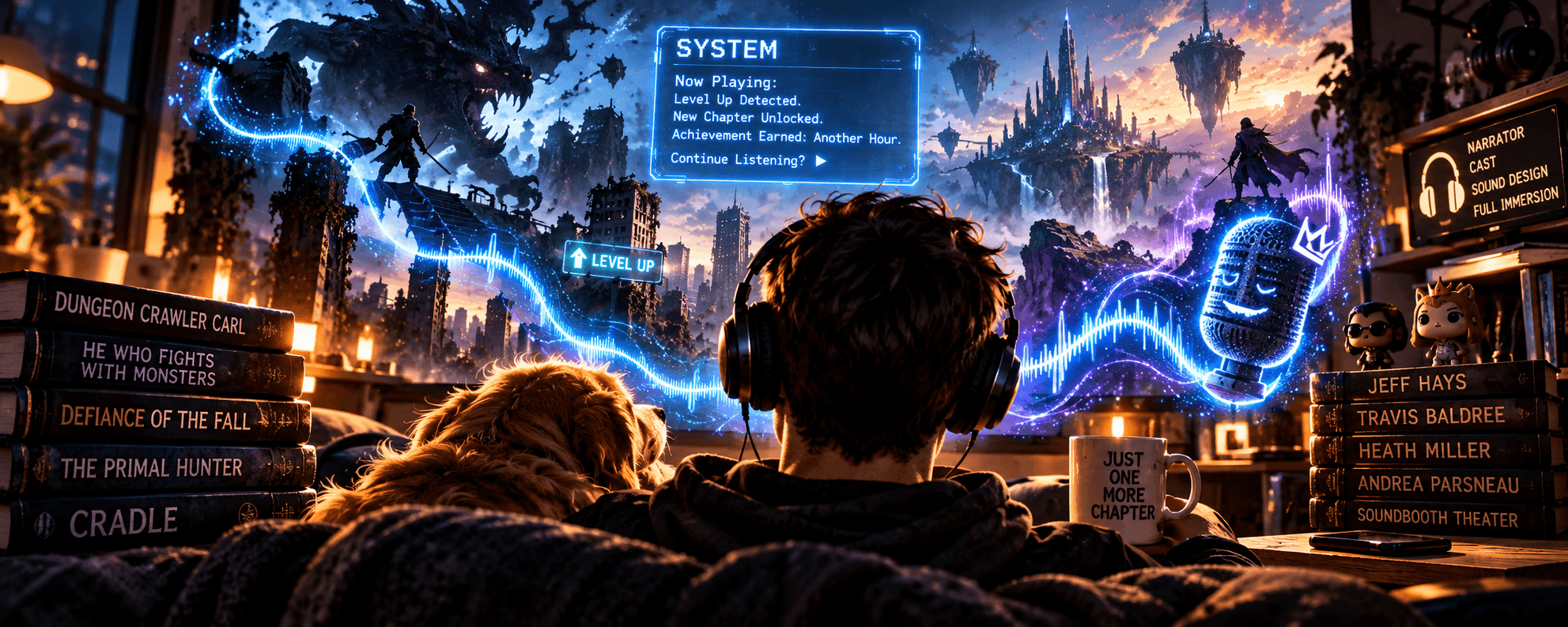
Why LitRPG Sounds Better Than It Reads: The Audiobook Thing
Ask around in any LitRPG community and you'll find a strange demographic split: a huge chunk of the audience has never read the genre at all. They've listened to hundreds of hours of it. For plenty of series the audiobook isn't a nice-to-have adaptation — it's the primary way the story is consumed, the version fans argue about, the release date people actually track. No other corner of fantasy skews this hard toward audio, and it's worth pulling apart why.
the format matches the life
Start with the obvious: these are long books in long series, and the people reading them tend to be busy. A 30-hour audiobook is a commitment in hardback, but in audio it's two weeks of commutes, gym sessions, and dishes. The genre's episodic structure — short chapters, constant small payoffs, cliffhangers engineered for a web serial's posting schedule — happens to be exactly the rhythm that works when you're consuming a story in 40-minute fragments of your day.
There's also the binge factor. LitRPG readers don't sample; they inhale. When a series has ten volumes averaging 20+ hours each, a listener can live inside one story for months. Audible's credit system quietly rewards this too — one credit for a 28-hour book is objectively the best deal on the platform, and the genre's audience has done that math.
system notifications are secretly a script
Here's the less obvious reason: LitRPG's most distinctive feature — the blue box, the level-up notification, the System's deadpan announcements — is kind of awkward on the page. It interrupts the prose. Some readers skim them.
In audio, those boxes become performance. A good narrator gives the System its own voice — flat, bureaucratic, cheerfully menacing — and suddenly the interruptions are the best part. The mechanical interludes that look like formatting on paper turn into a second character in your headphones. The genre accidentally wrote itself a radio-drama format: dialogue, action, and a disembodied announcer with impeccable comic timing.
Dungeon Crawler Carl is the canonical proof. Jeff Hays' production doesn't just read the book — it performs the game-show apparatus around Carl, from achievement pop-ups to loot box fanfare, and his Princess Donut is so definitive that a meaningful share of the fandom can no longer read her dialogue in any other voice. Plenty of people will tell you, with a straight face, that the series is better in audio. For a book built around an in-world broadcast, they might be right.
narrators become franchise actors
Traditional publishing treats narrators as interchangeable craftspeople. This genre treats them like cast members. A handful of names — Jeff Hays, Travis Baldree, Heath Miller, Andrea Parsneau — carry so much weight with listeners that their attachment to a new series functions as a review. "Narrated by X" is a purchase decision the way "starring X" is for a film.
That loyalty makes sense once you notice what the job actually is here. A narrator on a ten-book series voices the same characters for two hundred–plus hours. They're not reading a book; they're playing a role for years, and listeners build the same attachment they'd build to a TV cast. Travis Baldree's run on Cradle and Heath Miller's ongoing performance of He Who Fights with Monsters — where the comedy lives or dies on delivery — are the genre's equivalent of a long-running lead role. When a narrator change gets announced mid-series, the community reaction is indistinguishable from a beloved actor being recast.
Baldree is also the genre's best crossover story: a narrator so steeped in progression fantasy that he wrote his own cozy fantasy novel, narrated it himself, and hit bestseller lists — the pipeline flowing in reverse for once.
the economics follow the ears
All of this shows up in the money. For successful series, audio rights routinely become the most valuable piece of the property — it's common to hear authors say the audiobook out-earns the Kindle edition that spawned it. Production has scaled to match: what used to be one person and a microphone is now studios like Hays' Soundbooth Theater doing multi-voice casts, sound design, and effects, treating a dungeon crawl with the audio ambition other studios reserve for prestige drama.
That money loops back into how books get made. Release calendars bend around narrator availability. Authors write with performance half in mind — you can feel it in the genre's snappy dialogue and voice-driven humor, which plays better out loud than dense literary description ever could. The serial-to-Kindle pipeline now reliably ends at a recording booth, and everyone involved plans for it from the start.
if you've never tried the genre in audio
An honest recommendation: if you bounced off LitRPG on the page — if the stat blocks felt like spreadsheets interrupting a novel — try one series in audio before writing the whole genre off. The format hides the genre's most awkward habit and amplifies its best ones: voice, momentum, and jokes. Start with something performance-forward rather than crunch-forward, and give it a commute or two.
And if you're already an audio-first reader, know that you're not a weird offshoot of the fandom. You might be its center of gravity.
Enjoyed the list? LitRPG Central is a one-person project — if it helped you find your next read, you can buy me a coffee.