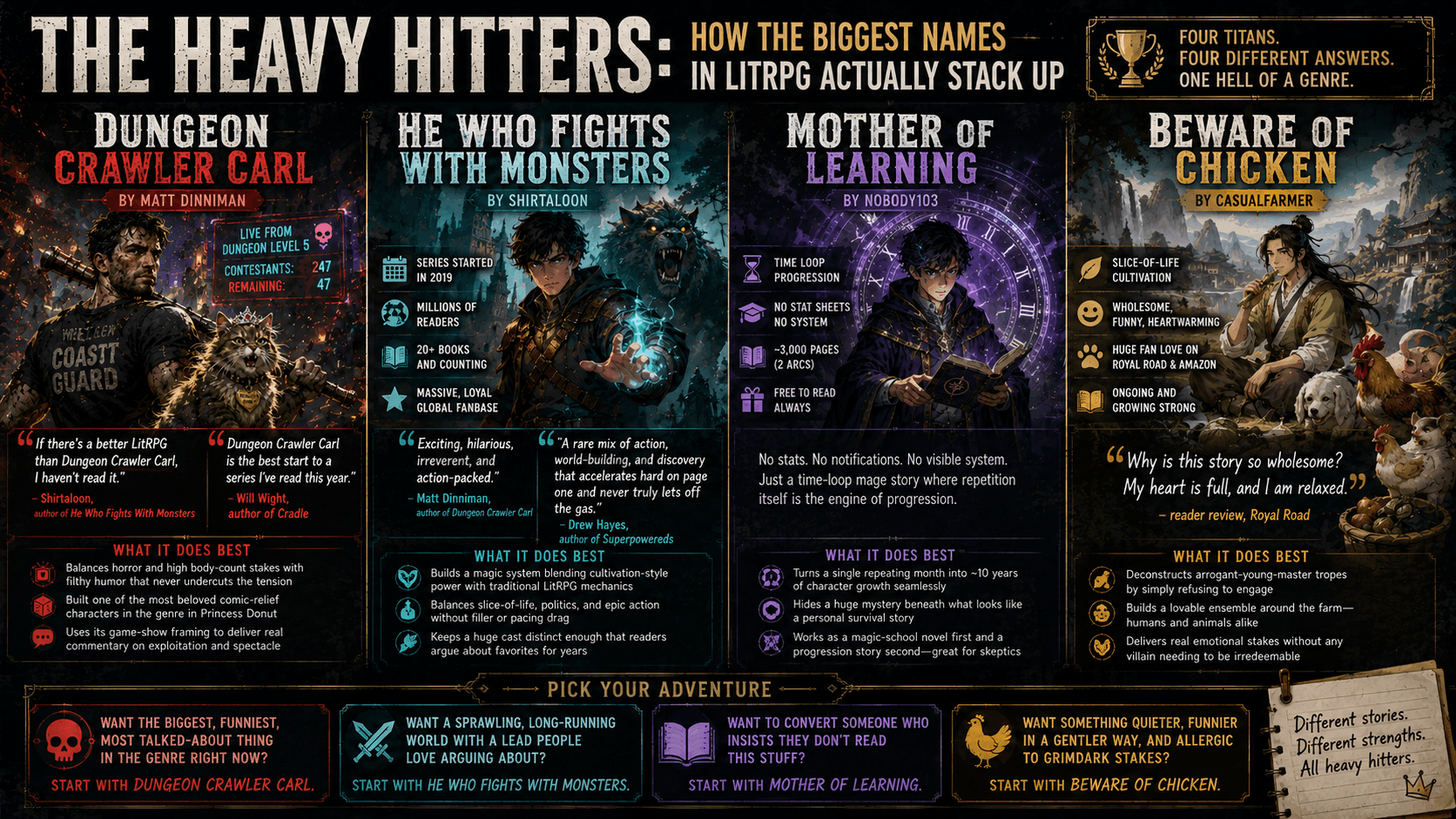
The Heavy Hitters: How the Biggest Names in LitRPG Actually Stack Up
A few names keep showing up near the top of every leaderboard, every recommendation thread, every "start here" post in this genre. They don't all do the same thing, though, and lumping them together as "the popular ones" undersells what makes each of them worth the time. So here's an actual look at four of the biggest, side by side, including what other authors in the space have said about each other's work, because it turns out this is a genre where the big names blurb each other constantly.
Dungeon Crawler Carl
Matt Dinniman's series about a Coast Guard vet and his ex-girlfriend's talking show cat surviving an alien-run dungeon reality show is, by pure numbers, the biggest thing in the genre right now. Ten million copies across the first eight books, a Peacock adaptation in the works, and a fandom that shows up to conventions dressed as decapitated sex-doll heads.
What makes it a heavy hitter isn't just the sales figures. Other authors in the genre keep pointing to it as a kind of ceiling to aim for:
"If there's a better LitRPG than Dungeon Crawler Carl, I haven't read it." — Shirtaloon, author of He Who Fights With Monsters
"Dungeon Crawler Carl is the best start to a series I've read this year." — Will Wight, author of Cradle
What it does best:
- Balances genuine horror and body-count stakes against constant, filthy humor without either one undercutting the other
- Built one of the most beloved comic-relief characters in the genre in Princess Donut, who never once becomes a gimmick
- Uses its game-show framing to sneak in real commentary on exploitation and spectacle without turning preachy
He Who Fights With Monsters
Shirtaloon's series about an Australian office manager reborn into a magic-and-monsters world has been running since 2019 and is still one of the most consistently recommended entry points into the genre. Jason Asano is a divisive lead by design, some readers love him, some can't stand him, but the series around him rarely gets called boring by either camp.
"Exciting, hilarious, irreverent, and action-packed." — Matt Dinniman, author of Dungeon Crawler Carl
"A rare mix of action, world-building, and discovery that accelerates hard on page one and never truly lets off the gas." — Drew Hayes, author of Superpowereds
What it does best:
- Builds a magic system that blends cultivation-style internal power with a more traditional LitRPG stat structure
- Balances slice-of-life and political intrigue against the action instead of treating them as filler between fights
- Keeps a genuinely enormous cast of side characters distinct enough that readers argue about their favorites years into the series
Mother of Learning
Already covered on its own here, but worth putting next to the others because it's doing something structurally different from all of them. No stat sheet, no notifications, no visible system at all. Just a time-loop mage story where the repetition itself is the progression engine. It's the one heavy hitter on this list you could hand to someone who's never touched the genre and never mention the word LitRPG at all.
What it does best:
- Turns a single repeating month into roughly a decade of character growth without the structure ever feeling like a gimmick
- Buries a genuine mystery under what looks at first like a personal survival story
- Works as a magic-school novel first and a progression story second, which is exactly why it converts skeptics
Beware of Chicken
CasualFarmer's slice-of-life cultivation story about a man reincarnated into a xianxia world who just wants to farm in peace is the odd one out on this list, and that's the whole appeal. It takes a genre, xianxia cultivation, that's usually built around ruthless competition and constant one-upmanship, and asks what happens if the protagonist just refuses to play that game.
The result reads less like a power fantasy and more like a comfort read with swords occasionally involved, and the reception backs that up:
"Why is this story so wholesome? My heart is full, and I am relaxed." — reader review, Royal Road
What it does best:
- Deconstructs the arrogant-young-master tropes of xianxia by simply refusing to engage with them
- Builds an ensemble around the farm, human and animal characters alike, that readers get attached to as fast as the lead
- Proves you can write genuine emotional stakes without a single villain needing to be irredeemably evil
picking between them
If you want the biggest, funniest, most talked-about thing in the genre right now: start with Dungeon Crawler Carl.
If you want a sprawling, long-running world with a lead people love arguing about: He Who Fights With Monsters.
If you want to convert someone who insists they don't read this stuff: Mother of Learning.
If you want something quieter, funnier in a gentler way, and allergic to grimdark stakes: Beware of Chicken.
They're all sitting near the top of the leaderboard for different reasons, which is really the point. "Biggest in the genre" doesn't mean one template repeated four times, it means four different answers to the same basic question of what makes a progression story worth finishing.