The Apocalypse Is a Job Posting: Why LitRPG Keeps Ending the World
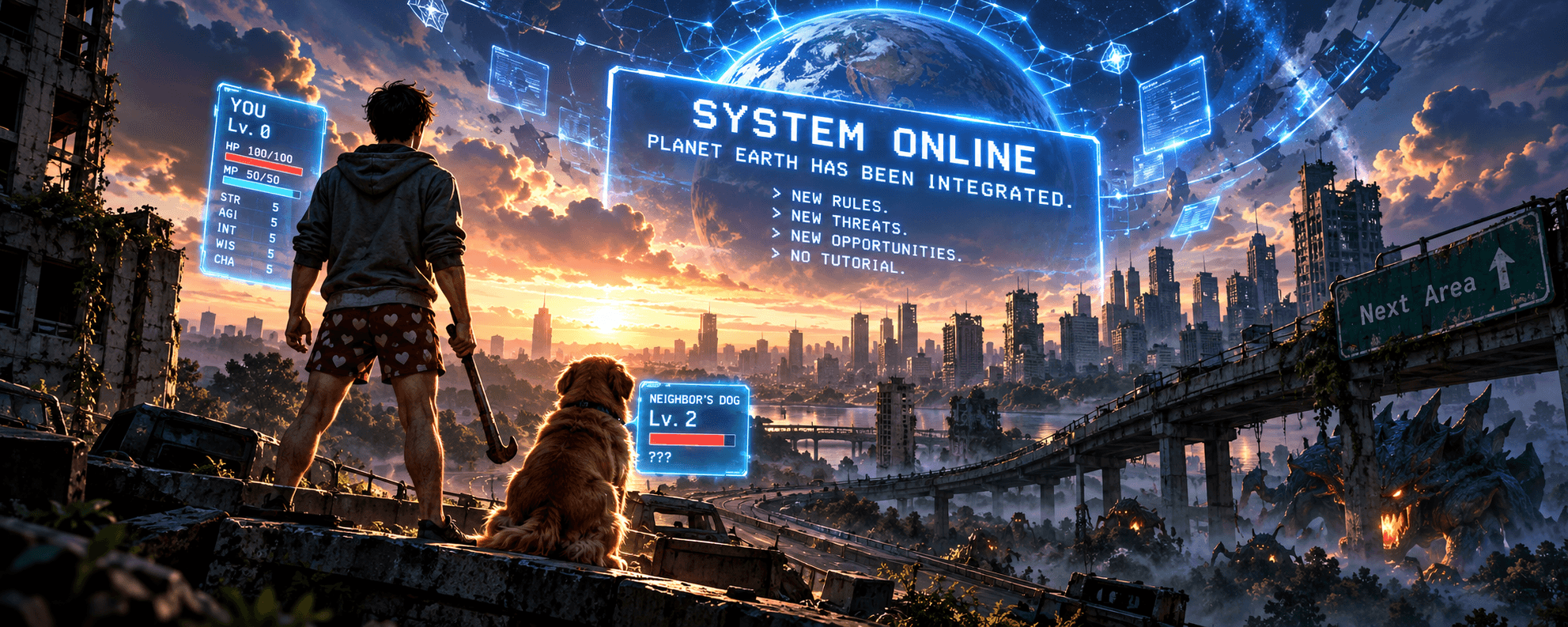
Somewhere along the way, LitRPG collectively decided that the best thing to do with planet Earth is total it. Not with nukes or zombies — with patch notes. One ordinary Tuesday, a blue box appears in front of every human being, gravity gets renegotiated, the neighbor's dog is now a Tier 2 threat, and civilization is handed a leveling system with no tutorial. The system apocalypse is arguably the genre's dominant setting at this point, and when a trope wins that decisively, it's worth asking what it's actually offering.
level zero is the whole trick
The quiet problem with most power fantasy is that the fantasy arrives pre-installed. The chosen one has the bloodline, the prophecy, the sword in the drawer. You're not watching someone become extraordinary; you're watching someone unwrap it.
The system apocalypse fixes this with demolition. When the System arrives, everyone is level zero — the accountant, the barista, the protagonist. Whatever the hero becomes by chapter three hundred, you were standing next to them at the starting line, and every scrap of power in between got acquired on the page, under rules you could read. It's the progression-system contract applied to an entire planet: nobody gets to be special by fiat, which makes earned specialness hit that much harder.
There's an honesty to it that secondary-world fantasy struggles to match. The character isn't a farm boy with a destiny. He's a guy who was outside in his boxers looking for a cat when the world ended — and Dungeon Crawler Carl understands that starting him there is exactly what makes everything after feel enormous.
the stakes live at eye level
Epic fantasy stakes are usually geography: the kingdom, the realm, the world. You're told to care about places you've never lived and thrones you'll never sit on.
A system apocalypse keeps the stakes at eye level, because the collapsing world is ours. The protagonist isn't defending Gondor; they're getting their kid sister across a city where the freeway overpasses have monsters under them now. Apocalypse Parenting builds an entire series out of the most eye-level version imaginable — surviving the end of the world while keeping three small children alive and reasonably well-behaved — and it works because the premise needs zero translation. Every reader already knows what's at stake in a grocery store with the lights out.
That's the emotional cheat code of the subgenre: it borrows the reader's own world as free worldbuilding, then spends its imagination budget on what the System did to it.
competence porn for the end of the world
Be honest about the appeal, though: the apocalypse in these books is not a tragedy. It's an opportunity with a body count. The office worker whose skills meant nothing on Monday is, by Friday, someone whose choices — which class, which skill, which fight — matter absolutely. The System is a brutal boss, but it's a fair one, which is more than a lot of people feel they can say about their actual economy.
The subgenre's biggest titles lean into this hard. Defiance of the Fall and The Primal Hunter both open with Earth getting integrated into a vast multiverse-scale System, and both are, at their core, stories about ordinary men discovering they are extremely good at the new rules. The wish being fulfilled isn't destruction — it's legibility. A world where effort visibly converts into power, where the grind provably pays. That fantasy says more about the audience's Monday than about its monsters, and the genre is refreshingly unembarrassed about it.
the trope has failure modes, and readers know them all
Spend time in the subgenre and you learn its recurring injuries. There's the why him? problem: everyone on Earth got the same System, so the story owes you a reason the protagonist pulls ahead that doesn't amount to authorial favoritism — the good entries make the answer temperamental (obsession, ruthlessness, spite) rather than lucky. There's the Earth stops mattering problem: series that open with the gut-punch of a transformed home planet often ascend into generic cosmic realms by book six, abandoning the very thing that made them resonate. And there's the scoreboard society problem: once levels are public, the interesting question is what happens to human institutions — the subgenre's best material is often governments, churches, and grifters adapting to the System, and its laziest entries skip all of it to get to the next dungeon.
That last one is the tell, honestly. You can grade a system apocalypse by how curious it is about everyone who isn't the protagonist.
why it won
So: a setting that deletes the chosen one, uses the reader's own world as its emotional foundation, converts economic anxiety into a fair and legible game, and generates conflict on every scale from "protect my family" to "survive the multiverse." Of course it won. The system apocalypse is the genre's thesis statement compressed into a premise — that growth should be earned, visible, and available to absolutely anyone, even you, even on a Tuesday.
The world ends, and for once, the door out is clearly labeled. It just has your stats on it.
Enjoyed the list? LitRPG Central is a one-person project — if it helped you find your next read, you can buy me a coffee.