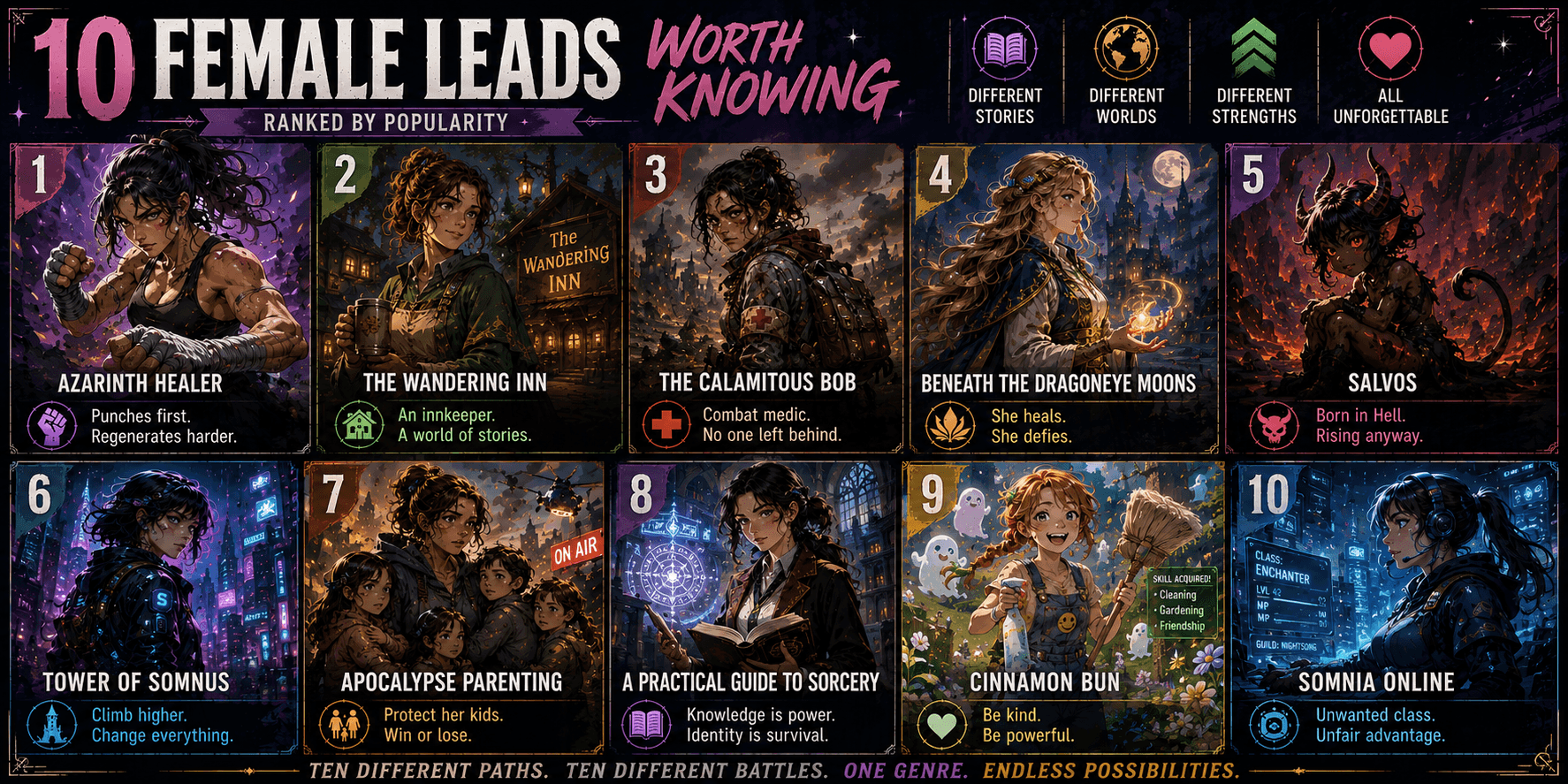
Ten Female Leads Worth Knowing, Ranked by Popularity
Filter the catalog down to female-led series and something interesting happens: the list isn't dominated by one flavor of story. You get a demon toddler clawing her way up a hellscape, a suburban mom defending her kids from an alien game show, a healer whose actual specialty is punching things, and a sorcerer who spends half her story disguised as a man. Here's the current lineup, ordered by popularity, with what makes each one worth your time.
Azarinth Healer — Ilea Spears
Top of the list, and for a specific reason: Ilea is not, despite the class name, primarily a healer. She's a kickboxer who got handed regeneration magic and immediately decided the best use of "can't permanently die" was picking more fights.
"Azarinth Healer has a great female lead who really punches with her fists in a very satisfying way." — Felicia Day, actor, producer, and New York Times bestselling author
What it does well:
- Treats its lead's love of violence as a genuine character trait, not a quirk that gets sanded off
- Balances slice-of-life food obsession against genuinely brutal combat without the tone whiplash feeling forced
- Keeps her power growth grounded by surrounding her with characters who are also strong, so she rarely feels untouchable
The Wandering Inn — Erin Solstice
Nineteen books in and still climbing, this is one of the longest-running web serials in the genre, and its lead deliberately avoids the fights everyone else in her world considers mandatory. Erin runs an inn. That's the whole pitch, and it's also exactly why people can't stop reading it.
What it does well:
- Turns a character who explicitly isn't a fighter into one of the genre's most compelling protagonists anyway
- Builds out one of the largest, most interconnected casts in web fiction without losing track of any of them
- Uses its sheer length to let relationships and consequences breathe in a way shorter series can't
The Calamitous Bob — Vivienne
A French combat medic gets yanked into a magical wasteland by a spiteful god and picked up the nickname Bob because the locals couldn't pronounce her actual name. It's darker and gorier than most entries on this list, closer to survival horror than power fantasy in its early stretch.
"An excellent series that follows a female MC, filled with goodness, inclusivity, and the cutest dragon." — reader review, Goodreads
What it does well:
- Gives its lead a medical background that actually shapes how she solves problems, instead of window dressing
- Doesn't shy away from real stakes; named characters die and it matters
- Builds a found-family dynamic around her that earns its warmth instead of assuming it
Beneath the Dragoneye Moons — Elaine
Elaine is reincarnated into a society that treats women as property, and the story doesn't pretend that away for comfort. She becomes a healer and adventurer specifically because the alternative on offer was marriage into a family she wanted no part of.
What it does well:
- Lets its setting's injustices actually matter to the plot instead of existing purely as backdrop
- Gives Elaine a specialization, healing, that the genre usually treats as a support role and makes it central instead
- Stretches across a genuinely enormous timeline, including sequences where she's lived long enough to become a legend herself
Salvos — Salvos
The odd one out structurally: a non-human lead, a newborn demon navigating a hellscape from literal infancy. It's a monster-evolution story crossed with a coming-of-age arc, and it commits to both halves.
What it does well:
- Uses its protagonist's non-human perspective to make otherwise-familiar leveling tropes feel new
- Builds real emotional stakes around a companion bond that the entire plot hinges on
- Handles the prejudice Salvos faces as a demon among humans without turning it into a single-issue morality play
Tower of Somnus — Kat Debs
A cyberpunk-meets-LitRPG series where the "game" world and the corporate dystopia Kat's stuck in constantly feed into each other. Power she earns while asleep in the Tower carries over into her waking life, which raises the stakes of every dungeon run considerably.
What it does well:
- Actually makes both halves of its dual setting, real world and game world, matter to the plot equally
- Gives its lead concrete, grounded motivations, debt, corporate control, family, instead of a vague call to adventure
- Uses its tower-climb structure to escalate steadily without the power creep feeling arbitrary
Apocalypse Parenting — Meghan Moretti
The premise alone makes this one stand out: an alien invasion turns Earth into a reality show, and the lead is a suburban mother of three trying to keep her kids alive through it. Most system-apocalypse stories treat children as background inconveniences. This one puts a parent's actual priorities front and center.
What it does well:
- Takes parenting seriously as the central conflict rather than a subplot squeezed around the action
- Uses its child characters as real stakes instead of props to be rescued
- Finds humor in the chaos of parenting through an apocalypse without undercutting the genuine danger
A Practical Guide to Sorcery — Siobhan
Worth a specific note here: Siobhan is female, but for a large stretch of the story she's magically disguised as a man named Sebastien in order to attend a university that banned her under her real identity. It's a different kind of "female lead" than everything else on this list, since a chunk of the plot is about managing a double identity rather than living openly as herself.
What it does well:
- Builds one of the more rigorously logical magic systems in the genre, closer to a puzzle box than a power fantasy
- Uses the dual-identity premise to explore how differently the same person gets treated depending on perceived gender
- Keeps Siobhan sharp and resourceful rather than leaning on brute strength to solve her problems
Cinnamon Bun — Broccoli Bunch
The tonal opposite of half the list above. Broccoli Bunch is a relentlessly cheerful sixteen-year-old who wants to purge a great evil and instead spends most of her time trying to hug menu boxes, befriend hostile ghosts, and generally out-nice a world built for grimmer protagonists.
What it does well:
- Commits fully to a wholesome tone without becoming toothless; bad things still happen, she just refuses to let them define her
- Turns skills the genre usually treats as jokes, cleaning, gardening, into genuinely useful tools
- Uses her naivety as an actual character trait she grows past, rather than a permanent gag
Somnia Online — Wren (Murmur)
A VRMMO story with a sharper edge than the "trapped in a game" premise suggests. Wren is a seasoned healer furious that the game auto-assigned her to a class she didn't want, and her fight to make Enchanter work on her own terms doubles as a slow unraveling of just how much the game's AI actually knows.
What it does well:
- Gives its lead a concrete, specific grievance, an unwanted class, that drives real strategic creativity instead of generic grinding
- Builds guild dynamics and rivalries that feel like actual workplace politics under pressure
- Lets the mystery of the AI's true nature creep in gradually instead of front-loading it as the whole pitch
the takeaway
Line these ten up and the thing that jumps out isn't a shared formula, it's how differently each one answers the same basic question. A demon infant, a combat medic, an innkeeper, a suburban mom, a disguised sorcerer, a cheerfully indestructible optimist: none of them got here by following the same playbook, and that's exactly why the tag is worth browsing instead of assuming you already know what's in it.