So What Actually Is LitRPG? A Non-Judgmental Explainer
the short version
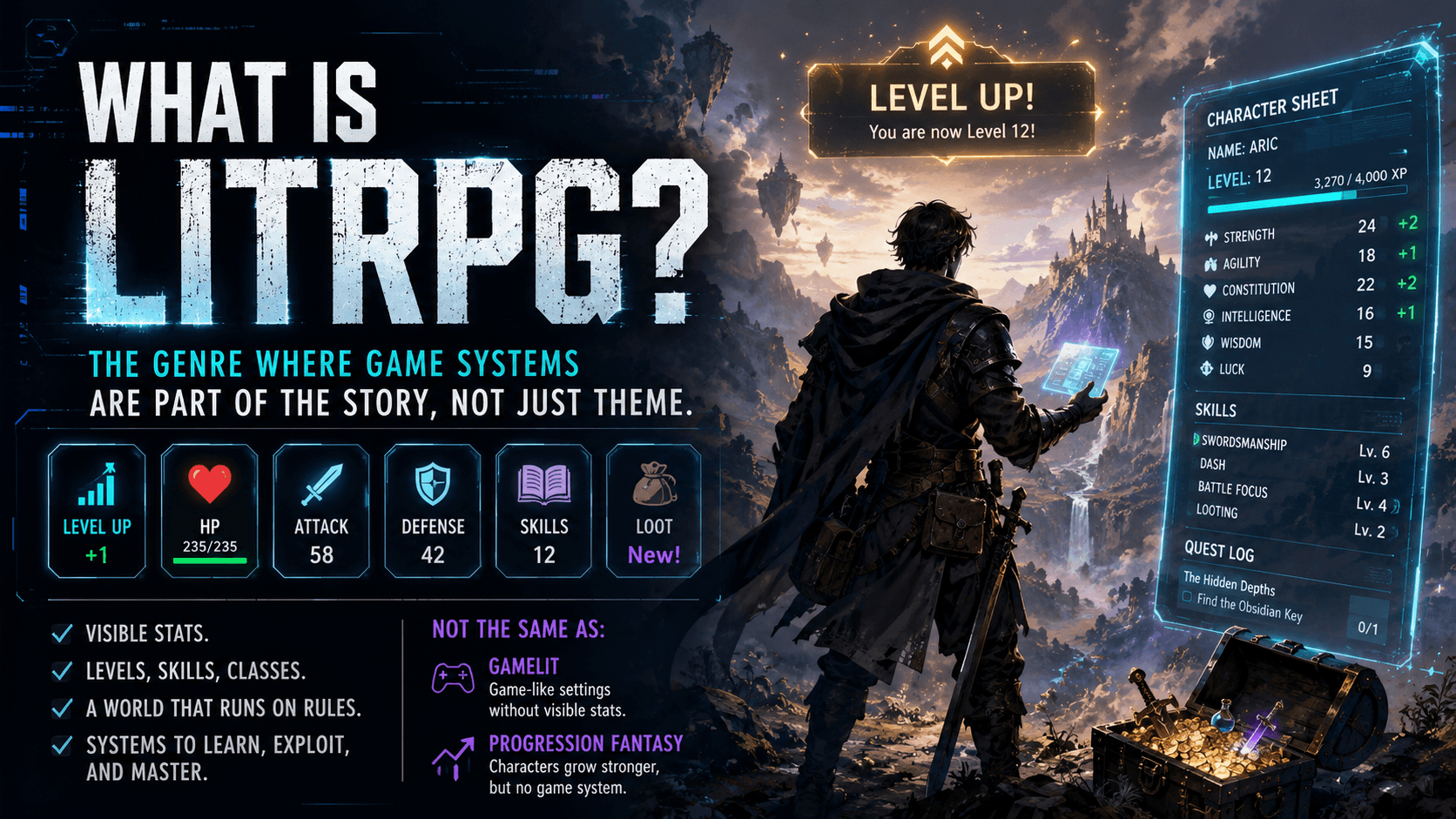
LitRPG stands for "literary role-playing game." It's fiction where the mechanics of a video game, stats, levels, skill trees, loot, quest logs, aren't just flavor in the background. They're part of the actual text. Characters see their own health bar. They get notifications when they level up. They read their own stat sheet the way you'd check your phone. The game system isn't a metaphor for growth, it's a literal object in the story that the character interacts with and often has to strategize around.
If a book just feels vaguely game-like but never shows you a character's actual strength score, that's probably a different genre wearing LitRPG's jacket. More on that in a second.
where the name came from
The term isn't old. It got coined in Russia in 2013, when EKSMO, one of the country's biggest publishing houses, started grouping a cluster of stat-heavy adventure novels under the label. A handful of authors, Dmitry Rus among them, had already been writing this kind of book on Russian self-publishing sites, and the publisher basically looked at what was already popular and gave it a shelf name.
From there it crossed over into English mostly through web serials. Royal Road became the place where writers could post chapters for free and build an audience before ever touching a publishing deal, and Kindle Direct Publishing gave people a way to sell directly to readers once they had one. Authors like Aleron Kong, whose The Land series is often credited as an early English-language entry, and later Matt Dinniman with Dungeon Crawler Carl, are a big part of why the genre found a real audience outside Russia.
what actually has to be in the book for it to count
There's no rulebook nailed to a wall somewhere, but readers generally expect a few things:
A character who is aware, on some level, that they're inside a system. They're not just getting stronger the way a hero in any fantasy book gets stronger. They're leveling up in a way the story treats as literal and quantifiable.
Visible stats. Strength, intelligence, whatever the world's version of a character sheet looks like. You're meant to watch the numbers move.
Skills, classes, or some kind of build. The character makes choices about how they grow, the same way you'd make choices in an actual RPG, and those choices matter mechanically, not just thematically.
A world that runs on rules the character can learn and exploit. Part of the fun is watching someone figure out the system well enough to bend it in their favor.
how it's different from its cousins
People throw around GameLit and progression fantasy as if they're interchangeable with LitRPG, and there's a lot of overlap, but they're not quite the same thing.
GameLit is the looser category. A story can feel like a video game, isekai portal fantasy transported into a game world, virtual reality settings, that whole vibe, without ever showing you a stat block. If the numbers stay in the background, or don't exist at all, that's GameLit rather than LitRPG.
Progression fantasy is about the character getting stronger over the course of the story, usually through a hero's-journey kind of arc. LitRPG almost always is progression fantasy, since leveling up is the whole point, but progression fantasy doesn't require an actual game system. A character in a progression fantasy novel might get stronger through training, magic, or sheer plot convenience, with no numbers ever shown on the page.
So the quick rule of thumb: if a book merely takes place in or near a game world, it's probably GameLit. If a character is getting stronger over time, it's progression fantasy. It becomes LitRPG specifically when the game logic is out in the open and the character is reading it the way you'd read a menu screen.
why people who don't even play video games end up loving it
This was the part that surprised me most. You don't need to have touched a controller in ten years to get hooked on this stuff. The appeal isn't really about gaming nostalgia, it's about watching a system get figured out. There's something deeply satisfying about seeing a character notice a loophole, or realize two abilities combine in a way nobody told them about, or grind through something painful and get to watch the payoff show up as a literal number going up. It scratches the same itch as a good heist story. You're watching someone understand the rules of their world better than the world expects them to.
where to start
If you want the version that's basically endless dungeon-crawling chaos with a lot of heart underneath it, Dungeon Crawler Carl is the obvious entry point. If you want something closer to a slow-burn mystery wrapped around a genuinely creative power system, that's where something like Level One God comes in. Either way, once you get used to reading a stat sheet as part of the story instead of a distraction from it, it's hard to go back to fantasy that doesn't show its work.