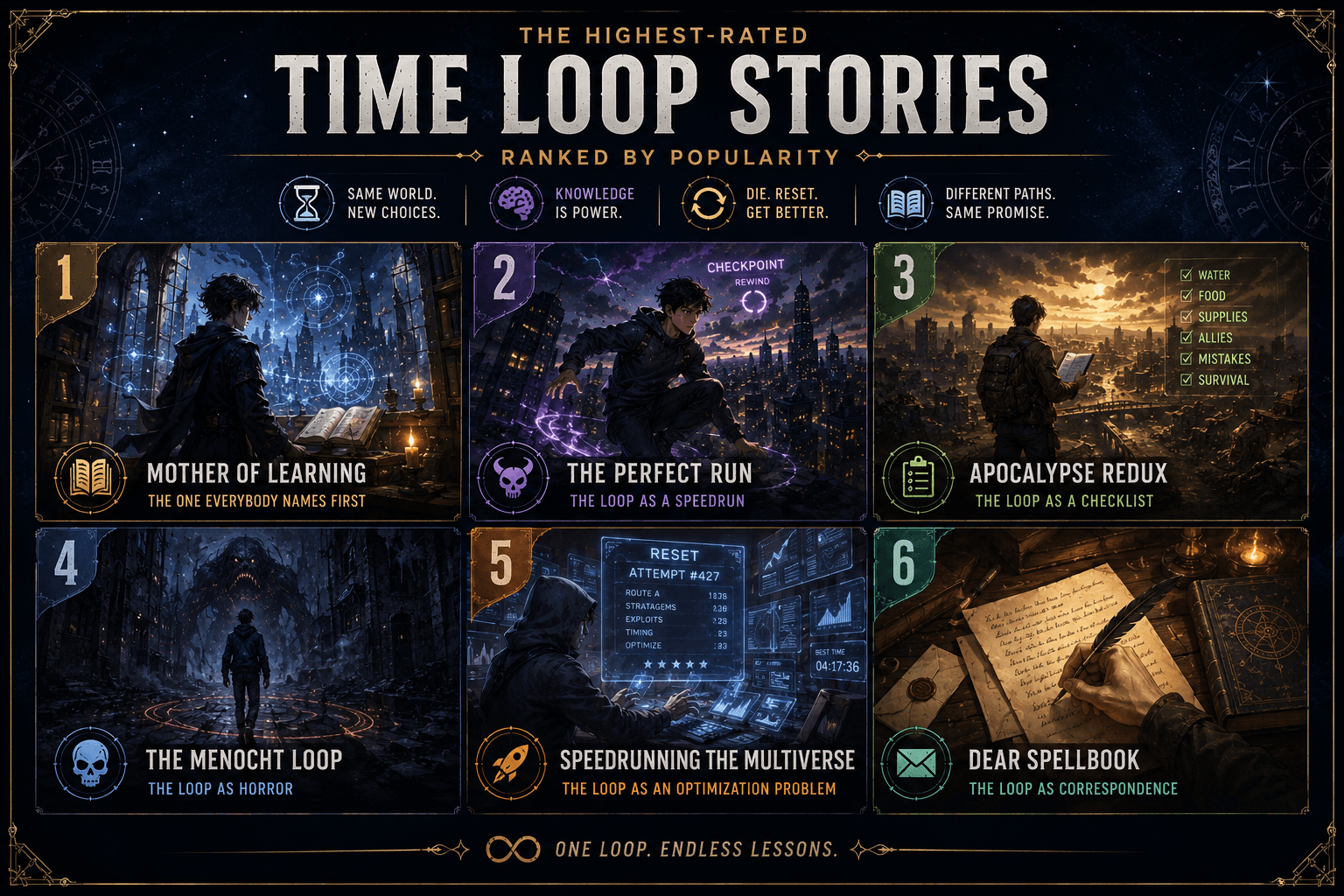
Six Time-Loop LitRPGs, Ranked — Because Dying Repeatedly Is a Progression System
Every LitRPG runs on the same promise: you get better because you keep trying. The time loop just makes that literal. Nothing carries over except what's in your head, which turns knowledge itself into the stat you're grinding — and turns dying into a mechanic instead of an ending. Here are the loops the catalog actually rates, ordered by popularity.
Mother of Learning — the one everybody names first
Zorian wants to sleep through the last month of the school year. The month has other plans, and so does the archmage who keeps blowing up the city on day thirty-one. It's the most-rated time loop in the genre for a reason: the magic system rewards study the way the loop rewards patience, and by the hundredth iteration Zorian has quietly become the kind of person who could actually stop this.
What it does well:
- Treats the loop as a school for one, with homework that takes lifetimes
- Reveals its plot at exactly the rate you learn to read it
- Ends. Actually ends, four books in, with the answers on the table
The Perfect Run — the loop as a speedrun
Ryan Romano has one power: rewind to his last checkpoint. What he does with it is play his own life like a game where death is a reload and the run has to be stylish. Comedy, tragedy, and superheroics compressed into three volumes that never once slow down.
What it does well:
- The loop as an excuse for maximum recklessness, which is exactly what a checkpoint should enable
- A cast that changes across resets even though only Ryan remembers
- The tightest plotting on this list — three books, no padding
Apocalypse Redux — the loop as a checklist
Twelve years of the apocalypse, and Isaac lost. Waking on day one with all of it in his head, he does the least heroic and most satisfying thing possible: he prepares. No chosen-one revelation, just a man with a spreadsheet of every mistake humanity is about to make.
What it does well:
- Foreknowledge as a resource that depletes as the timeline diverges
- Grinding as strategy: he isn't stronger, he's earlier
- The dread of knowing what's coming on a schedule
The Menocht Loop — the loop as horror
Ian is trapped in a dead city with a monster and no exit, and the loop is not a gift — it's a cage with excellent acoustics. Darker and stranger than everything above it, and it takes the psychological cost seriously: what does repetition do to a person who can't stop?
What it does well:
- Actual dread; the reset is a threat, not a safety net
- A power system that grows genuinely alien as it deepens
- Complete, so the cage has a door
Speedrunning the Multiverse — the loop as an optimization problem
If you had unlimited attempts at a world, what's the fastest possible route to power? This one asks the gamer's question with a straight face and answers it with routes, exploits, and the kind of joyful min-maxing that treats reality as a game to be broken.
What it does well:
- Explicitly speedrunner-brained: routing, resets, frame-perfect nonsense
- Escalates scope without losing the joke
- Rewards readers who like their protagonists smug and earning it
Dear Spellbook — the loop as correspondence
The smallest and strangest entry: a loop story told partly through what a man writes to himself, learning magic in a world that would rather he didn't. Quiet, clever, and worth the detour if the bigger names have already been read.
What it does well:
- An epistolary framing that only a loop story could use
- Magic that has to be reasoned out, not granted
- Short enough to finish in a weekend
Enjoyed the list? LitRPG Central is a one-person project — if it helped you find your next read, you can buy me a coffee.