Nobody's First Draft Is a Paperback: How a LitRPG Actually Gets Made
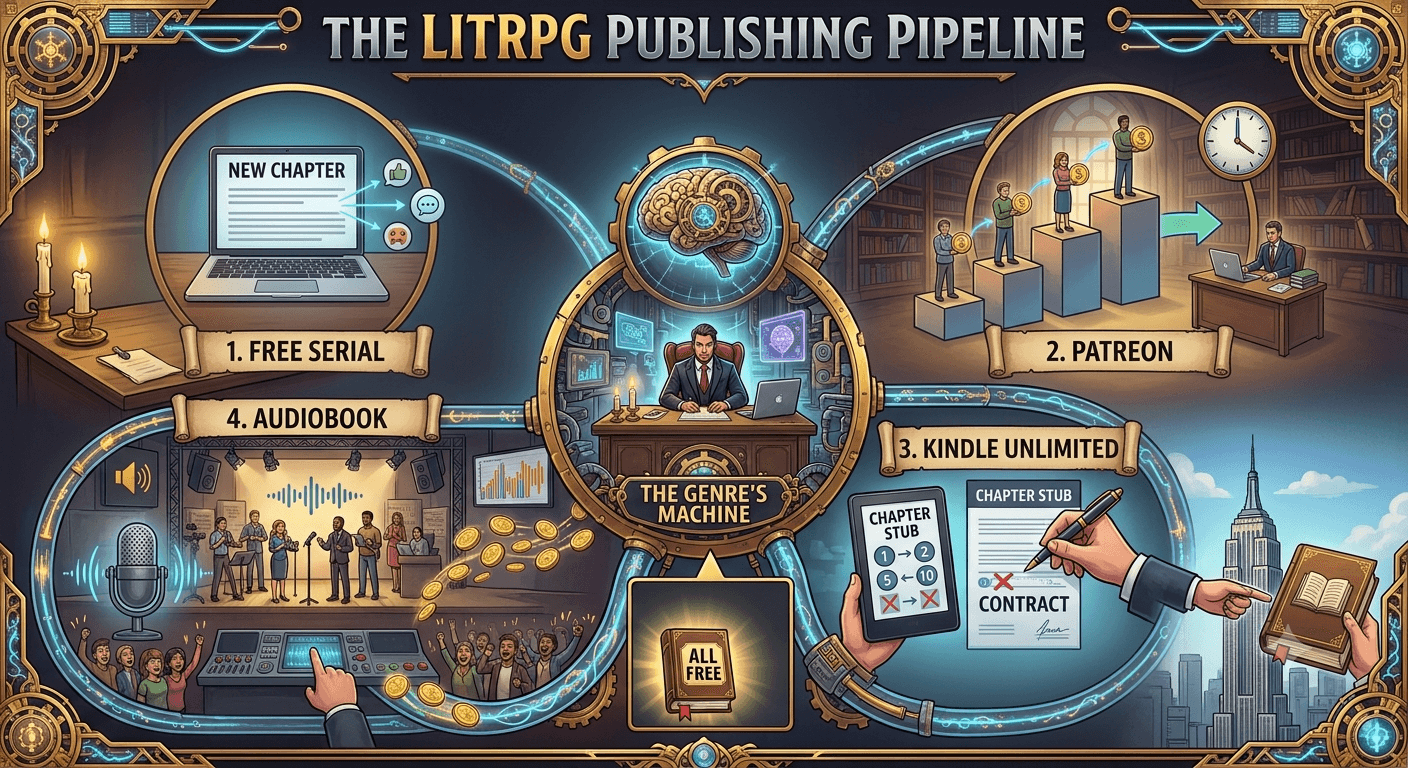
If you came to LitRPG from traditional fantasy, the way these books get made probably looks backwards. There's no agent, no publisher's marketing plan, no hardcover launch. The book you just bought on Amazon very likely started as free chapters posted three times a week by someone with a day job, and the version you're reading is the third or fourth financial life that same story has lived. That pipeline — serial, then Patreon, then Kindle, then audio — explains almost everything people find strange about the genre: why the books are enormous, why series run to twelve volumes, why chapters sometimes vanish from the internet, and why your favorite author publishes faster than you can read.
So here's how the machine actually works.
it starts free, on purpose
Most of the genre's biggest series began as web serials on Royal Road, posted chapter by chapter, free to anyone. That's not charity and it's not amateurism — it's the audition. A serial that climbs Royal Road's popularity lists has proven, with receipts, that thousands of people will show up multiple times a week for this exact story. The author gets something traditional publishing can't offer: a live audience giving feedback in the comments while the story is still being written, and a follower count that functions as a business plan.
The readers get something too. You can read an absurd amount of this genre without paying a cent, and the serials that survive the climb tend to be the ones that hook people fast, because a free reader who's bored closes the tab. It's a brutal filter, and it shapes the genre's pacing — those constant small payoffs LitRPG is known for are partly an artifact of needing to earn the next click three times a week.
patreon turns readers into payroll
Once a serial has an audience, the author opens a Patreon, and the standard offer is beautifully simple: pay a few dollars a month and read ahead. Five chapters ahead, ten, sometimes twenty or more, with tiers priced by impatience. Nothing is being sold except earlier access to something that will eventually be free anyway — and it works so well that for a successful serial author, Patreon is often the difference between "hobby" and "quit the day job."
This is also why release schedules in this genre are so relentless. The Patreon model pays for consistency, not for perfection. An author who ships three chapters a week, every week, keeps their backers; an author who disappears for six months to polish does not. Whatever you think of the prose that schedule produces, it's a genuinely different way of financing fiction, and the authors who thrive under it are closer to showrunners than to novelists.
then the serial becomes a "book," and chapters start disappearing
Here's the part that catches new readers off guard. When a serial gets big enough, the author packages the early arcs into ebooks and puts them on Amazon — almost always enrolled in Kindle Unlimited, because that's where the genre's paying readers are. But KU requires exclusivity: content in the program can't be freely available elsewhere. So the author deletes most of those chapters from Royal Road, leaving what everyone calls a stub — the first handful of chapters and a link to Amazon.
If you've ever followed a link to a beloved serial and found forty chapters where there used to be four hundred, that's what happened. It isn't the author being precious; it's a contractual requirement of the program that pays their rent. Kindle Unlimited pays per page read — a small fraction of a cent per page — which quietly explains another genre signature: the books are huge because length is literally revenue. A 250-page novel and an 800-page novel take similar effort to market, and one of them earns three times as much per borrow.
Not everyone plays it this way. The Wandering Inn, one of the longest works of fiction ever written in English, keeps the entire serial free to read on its own website and funds itself through Patreon and audiobooks instead — proof that the stub is a choice, though for most authors it's not a hard one.
the audiobook is the actual jackpot
For the genre's top series, the surprise is that the Kindle edition might not even be the main event. LitRPG is a disproportionately audio-consumed genre — long series, binge-friendly structure, an audience that listens while commuting or grinding through chores — and a strong audiobook deal can out-earn everything that came before it. It's common for a series to hit Audible with production values the print edition never saw: dedicated narrators, full casts, sound design.
This is why you'll sometimes see a series' release calendar organized around audio. The narrator's schedule can gate the whole pipeline, and "the audiobook drops next month" generates more community excitement than the ebook ever did. Series like He Who Fights with Monsters and Defiance of the Fall built enormous audiences this way — serial first, Kindle second, audio as the tide that lifted everything.
and sometimes, at the very end, traditional publishing shows up
The final stage of the pipeline is the funniest one: after a series has already succeeded on Royal Road, on Patreon, on Kindle, and on Audible, a traditional publisher occasionally arrives to offer the thing it still uniquely controls — bookstore shelves. Dungeon Crawler Carl is the flagship example, picked up for print editions by a major publisher years after it was already a phenomenon. The order of operations has fully inverted: New York isn't discovering these books, it's licensing proof.
why this matters if you're just here to read
Knowing the pipeline changes how you navigate the genre. It tells you why book one of a series is often still free as a Royal Road stub — try before you buy is built into the business model. It tells you that a "12-book ongoing series" isn't a warning sign the way it might be elsewhere; it's the natural shape of fiction funded by people who want it to continue. It tells you why quality can wobble mid-series (the chapters you're reading were written on a treadmill) and why it often recovers (the same chapters got a second edit on the way to Kindle).
Mostly it tells you that this genre isn't an outgrowth of publishing at all. It's an outgrowth of the internet — and the books read like it, for better and for worse, usually both at once.
Enjoyed the list? LitRPG Central is a one-person project — if it helped you find your next read, you can buy me a coffee.